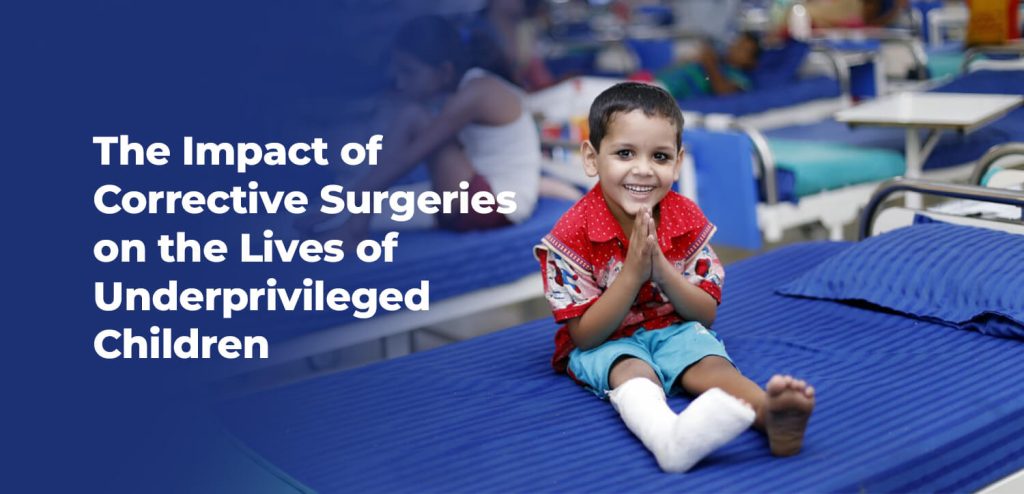


Every child should have the right to run, play, and discover the world freely. And to millions of poor children born with a physical deformity or disability, it is not possible to stand on their own feet or walk. Corrective surgeries can do wonders by altering not only the physical but also the emotional, social, and economic aspects of lives.
There are several charitable medical and community-based healthcare programmes, such as Narayan Seva Sansthan, that are saving the lives of children everywhere around the globe by giving them a second opportunity to live. Through free medical treatment, rehabilitation, and caring support structures, thousands of kids are becoming mobile and independent annually.
“A single surgery can bring a change for a lifetime.”
Let’s know the impact of the Corrective Surgeries, which reinstates dignity in the underprivileged children, and changes their lives.
Corrective Surgeries: Why They Matter?
Corrective surgeries refer to medical procedures aimed at curing congenital disabilities or diseases induced by illness or injury. These surgeries are done to recover the mobility and physical functioning, as well as the general quality of a child’s life.
The poor children in the underprivileged communities are often afflicted with:
- Clubfoot
- Polio-related deformities
- Congenital abnormalities of limbs
- Movement-related orthopaedic conditions
These conditions may prevent children from having the opportunity to use their time at school, engage in social activities, or live freely without proper medical care. Through corrective surgeries, these issues can be corrected by positioning bones in the right location or repairing muscles or structural deformities.
More than 450,000 free corrective surgeries have already been carried out on children with disabilities in Narayan Seva Sansthan’s global humanitarian medical programmes so that they can stand and walk on their own. Such surgeries go far beyond curing physical illnesses; they cure the confidence and provide opportunity.
Struggles of Underprivileged Children with Disabilities
Physical disability is usually accompanied by social and economic complications in children who live in poverty. A lot of families are not able to pay for medical care, travelling, and recovery services, and most of these include rural or low-income neighbourhoods. This leaves children with treatable conditions untreated for years.
The consequences may be disastrous:
#1 Limited access to education
Children who are unable to walk easily or who are stigmatised by obvious deformities tend to drop out of school or not to attend at all.
#2 Social isolation
Such physical impairments may result in not being able to participate in play, social events, and community.
#3 Economic or financial hardship for families
Parents might have to quit work so as to take care of their child, further worsening economic hardships.
#4 Emotional and psychological effect
Children who observe others living freely may develop low self-esteem and helplessness.
How Corrective Surgeries Transform Lives
When a child is taken through a corrective surgery, the change is usually sudden and life-altering. What was impossible yesterday turns out to be possible today.
These are some of the most effective ways through which these surgeries affect the lives of children.
1. Rebuilding Mobility and Independence
The most evident post-operative change is the independence of standing, walking, and moving.
This is no less than a miracle to children who have spent years crawling or depending on others to get around. A child who previously had a problem with movement will possibly be able to walk to school, play with peers, and engage in normal activities.
Artificial limbs, callipers, wheelchairs, and rehabilitation can also be offered by many humanitarian programmes as a guarantee of mobility in the long term.
To move is to be free, and the surgery opens the door to freedom.
2. Restoring Confidence and Self-Esteem
Children with physical deformities are usually discriminated against and stigmatised.
The psychological change can be as important as the physical one after the corrective surgery. Children who previously shunned social engagements start to interact with other students with confidence.
- They rediscover childhood
- They rediscover themselves
“Hope begins when a child makes the first step.”
3. Opening Doors to Education
One of the most effective ways of ending the poverty cycle is education. Unfortunately children sometimes cannot go to school due to disabilities.
Corrective surgeries transform this fact.
Once children walk again, they are able to go to school, sit comfortably in the classrooms, and engage in physical exercises.
This is a good start to a brighter future for many families.
4. Empowering Communities and Families
In a case where a child is disabled and cannot move freely, the family is affected as a whole.
Parents might have to spend much time and resources on caring, which invariably results in lost job opportunities. There is also an emotional or financial impact on the siblings.
Corrective surgeries remove this burden, as they help the child to regain independence.
Families become strong, and communities are empowered to have individuals who can make a valuable contribution to the community.
The Role of Donors in Making Surgeries Possible
Medical interventions that transform lives demand proper surgeries as well as post-surgical treatment, which may cost a lot.
This is where the role of compassionate donors comes in and makes a remarkable difference.
A Corrective Surgeries Donation aids in covering key factors of treatment, including:
- Surgical procedures
- Hospital care
- Rehabilitation and physiotherapy
- Prosthetic limbs or mobility devices
- Patient travel and accommodation
Even a small donation can help finance an entire surgery for a child in need in many charitable healthcare programmes.
As an example, the UK has donors who can sponsor surgeries that would enable the poor children to walk for the first time. Whenever a person decides to donate to Corrective Surgeries in UK charities, like donating to Narayan Seva Sansthan UK, they are providing direct support to the life-transforming medical services to needy children.
Conclusion
Surgeries are not simple medical procedures, but they are life-altering experiences that reinstate independence and hope in the lives of poor children. With the help of generous donors, hard-working volunteers, and other humanitarian programmes across the globe, thousands of children who earlier lived with physical challenges are walking boldly towards better lives.
Such an organisation that has done an incredible service in this mission is Narayan Seva Sansthan UK, which contributes to providing free corrective surgeries, rehabilitation services, and mobility aids to the unfortunate disabled person. Its work already shows how the power of collective compassion can save lives on a large scale by conducting hundreds of thousands of successful surgeries.
By donating to Corrective Surgeries Donation, people in the UK will have a chance to join this life-saving movement.
“The best thing we can sometimes offer a child is a second chance to stand, walk, and dream.”
FAQs
- What are corrective surgeries?
Corrective surgeries are medical operations intended to correct hereditary deformities, disabilities, and body constructions that interfere with mobility and physiological ability.
- What are the benefits of corrective surgeries to poor children?
They help children walk, feel more confident, and go to school and lead a normal life.
- What can be done by the UK people to promote corrective surgeries?
People may be involved in Corrective Surgeries Donation, fundraising, volunteering, and sponsoring life-altering medical surgeries.
- Do charity organisations have corrective surgeries with rehabilitation?
Yes. Physiotherapy and mobility support are the most common after-surgery methods aimed at ensuring the long-term recovery and independence of children.